Research

Studying complex systems with formal tools and weird ideas.

Formally verified AI

AUFBAU

A decoder enforcing semantic constraints on LLMs.

In many workflows LLMs will violate semantic guidelines, thus preventing them from acomplishing their task. For example, agents will sometimes forget the shape of their tool calls, mistake the type of an in-context variable, or perform unauthorized operations on data.

AUFBAU builds, token by token, continuations that keep a partial syntax tree well-formed and well-typed according to user-definable attributes on a context free surface. These attributes are generic, from type constraints to relational rules between objects.

In short, you can give hard rules your LLMs will always follow.

grammar
Variable(var) ::= Identifier[x]
BaseType ::= Identifier | '(' Type ')'
AtomicType ::= BaseType | '(' Type ')'
FunctionType ::= AtomicType '->' Type
Type ::= AtomicType | FunctionType
Lambda(lambda) ::= 'λ' Identifier[a] ':' Type[τ] '.' Expression[e]
AtomicExpression ::= Variable | '(' Expression ')' | Lambda
Application(app) ::= Expression[l] AtomicExpression[r]
Expression ::= AtomicExpression |  Application

x ∈ Γ
----------- (var)
Γ(x)

Γ[a:τ] ⊢ e : ?B
--------------------------- (lambda)
τ → ?B

Γ ⊢ l : ?A → ?B, Γ ⊢ r : ?A
--------------------------------- (app)
?B

Revolutionary text corpus

KARL

A corpus of revolutionary press, and a training design that keeps an international base separate from a situated post-training.

KARL assembles a corpus of revolutionary press and archives to train a writing model on an intended base of Marxist classics in several languages. The unit is the article or the whole chapter, never an arbitrary chunk, and the political line is set in post-training rather than in the pretraining data.

SFT pairs are built backwards: the response targets are published texts, not generated answers, and only the question that elicits each text is produced. The corpus and pipeline are in progress; the code is private and there are no public checkpoints or datasets yet.

international base classics from marxists.org, in many languages unsupervised pretraining chapters, no instruction format situated post-training SFT: the published article is the answer; only the question is generated
An international base, a situated post-training. The design keeps the politics in the second stage and the training signal in the published texts.

Critical AI & Information research

SLOP

A framework that queries diffusion models in their own latent space.

SLOP queries a diffusion model directly in its latent space. It captures latents, noise predictions and embeddings as the model generates. It measures how the model renders identity, geography and politics, and where those biases sit as geometry in that space.

Inference runs on restricted HPC. The client tunnels a binary protocol over SSH to a GPU node with no open ports. Stable Diffusion and Flux are supported. A distilled-checkpoint registry keeps a sweep affordable.

SLOP produced the visualisations used in the Holy Slop installation. It was shown in The World Through AI at SCHIRN, and in Hidden Layers at UC Berkeley.

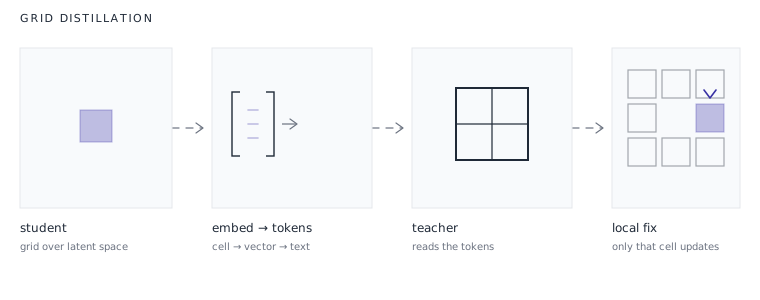
Local latent distillation: the student's latent space is gridded, a cell's embedding becomes tokens, and the teacher corrects that cell
To study a closed source model, we distill local elements of it's latent space using grid based sampling and embedding reconstruction by combining tokens.
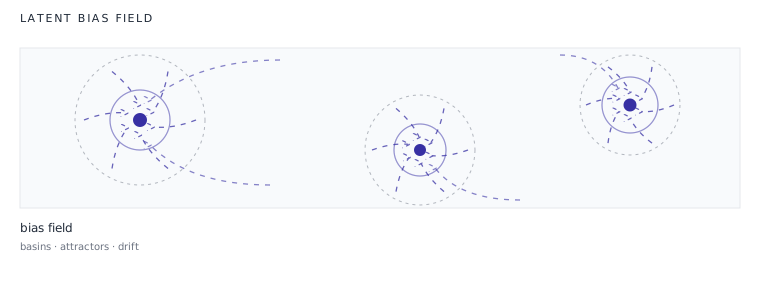
The latent bias field: a handful of attractor basins, each pulling nearby seeds
In a given diffusion field (parametrized by a prompt) we identify low-dimensional attractors relating to concepts

Publications

Published · October 2026

Semantic Prefix Oracles for LLM Decoding: Contracts and Differential Validation

Association for Computing Machinery

Paul Kronlund-Drouault

In Proceedings of the 2nd ACM SIGPLAN International Workshop on Language Models and Programming Languages (LMPL '26), October 4–9, 2026, Oakland, CA, USA, pages 13–23.


ACM Digital Library DOI 10.1145/3843750.3843841 CC BY 4.0 — open access

Exhibition · 2026

Holy Slop! A Generative Atlas of Slopaganda in Palestine

SCHIRN Kunsthalle Frankfurt University of California, Berkeley

Using our SLOP framework we produced visualizations used in a piece of the World Through AI exhibition at SCHIRN Kunsthalle in Frankfurt, later shown in Hidden Layers at UC Berkeley. The piece displayed visualizations of differential diffusion fields between neutral embeddings and a Palestinian identity prompt. We identified racist and orientalist representations that matched to attracting areas of the diffusion field.